
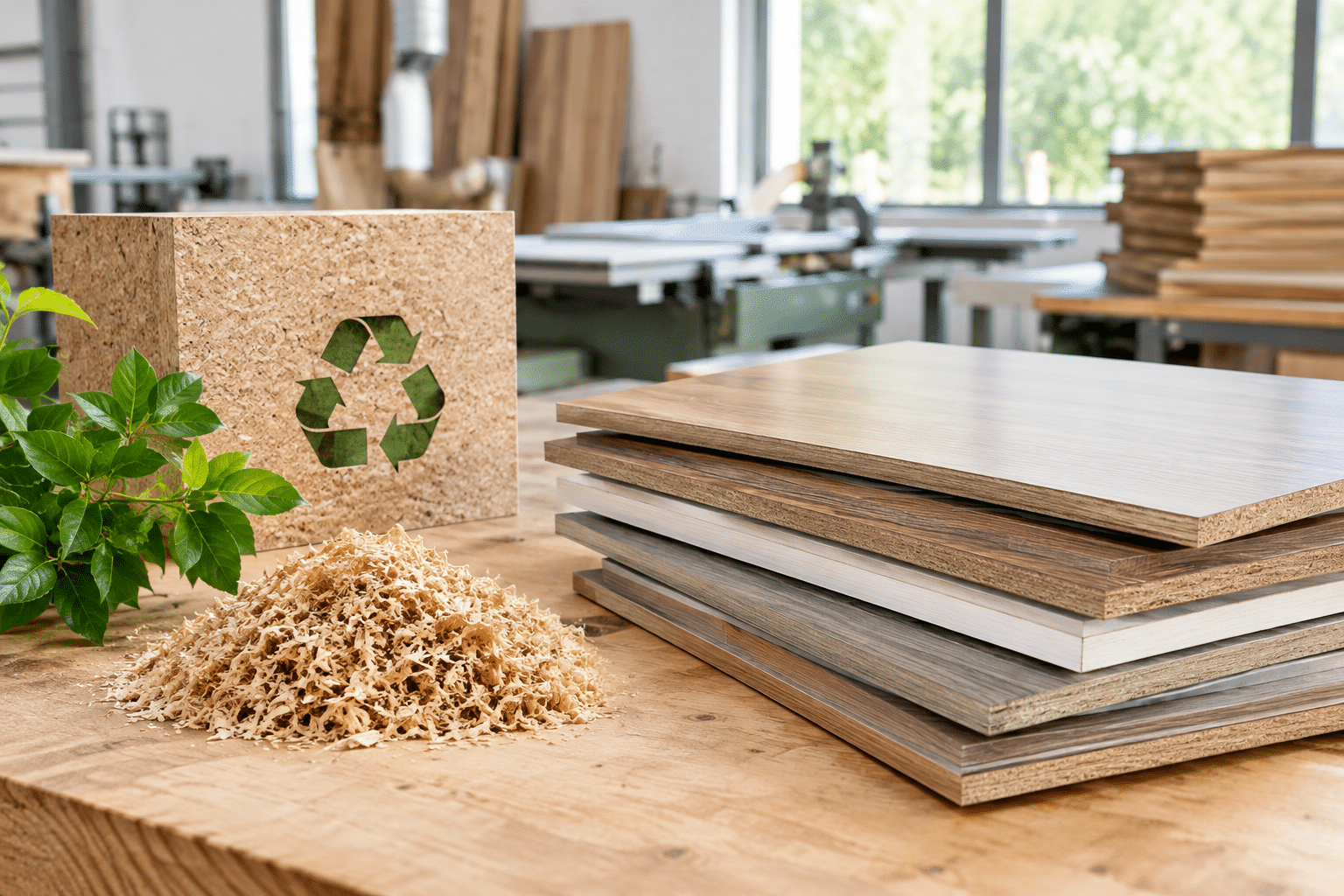
A typical cabinet shop running solid wood doors loses 30 to 40 percent of its raw board footage to rips, defects, sanding dust and rejected parts. Sustainable laminate solutions change that math by starting with an engineered substrate and a thin decorative film, which pushes usable yield above 90 percent on most component programs. The waste and carbon reductions in woodworking manufacturing come less from one hero product and more from how the surface, substrate, adhesive and press cycle work together.
Where the Waste Actually Happens in a Wood Shop
Scrap in millwork and cabinet production clusters in a few predictable places, and laminate programs touch almost all of them. Lumber defecting, edgeband offcuts, finish overspray and rework after damage during shipping account for the bulk of landfill-bound material in a mid-sized plant.
- Lumber defecting: knots, checks and color mismatch pull 15 to 25 percent of rough stock out of the running before machining starts.
- Finishing losses: conventional spray systems transfer roughly 40 to 70 percent of the coating to the part, with the rest captured in filters and booth waste.
- Edgebanding: every linear foot of band leaves trim scrap, glue purge and a seam that can fail later.
- Rework and warranty returns: swollen edges and delaminated corners on low-grade parts drive replacement production, which doubles the embodied carbon of that component.
The U.S. EPA tracks wood as one of the larger durable-goods waste streams by weight, and most of what leaves a cabinet plant is not recoverable once it has been coated or glued. Reducing the scrap at the machining stage is cheaper than finding a downstream home for it.
Why 3D Laminate Eliminates the Edgeband Problem Entirely
In membrane pressing, a single sheet of thermoformable film wraps the face, profile and edges of an MDF component in one cycle, so there is no separate band, no trim scrap and no glue line at the corner. A press running 3 to 5 minutes per cycle can produce 20 to 40 doors depending on size, with film utilization in the 85 to 95 percent range once nesting is optimized.
That single-pass approach also removes the finishing booth from the equation for those parts. No stain, no sealer, no topcoat, which means no solvent evaporation and no filter waste attached to the component. Shops moving profiled doors to textured 3D laminate commonly report that the finishing department becomes their smallest waste contributor rather than their largest.
Recycled PET Film and the Closed-Loop Argument
PET-based decorative films give manufacturers something PVC never could: a mono-material surface that fits an existing recycling stream. Films made with post-consumer recycled PET pull material out of the bottle waste stream and keep it in service as a durable surface for 15 years or more.
The sustainability case rests on three measurable points rather than marketing language:
- Feedstock displacement: recycled content reduces virgin resin demand, and the energy to reprocess PET flake is substantially lower than producing new polymer.
- No chlorine chemistry: PET avoids the end-of-life concerns associated with chlorinated films in incineration.
- Thin-gauge efficiency: decorative films typically run 0.12 to 0.5 mm, so the decorative layer adds very little mass per square foot of finished surface.
Our ReCover recycled PET film line was built around that logic, and the broader approach is covered in more detail in our look at environmentally friendly decorative laminate products.
Substrate Choices Carry More Carbon Than the Film
In most laminated components, the substrate represents 90 percent or more of the part’s weight, so substrate sourcing drives the carbon number far more than the decorative layer. MDF and particleboard are usually manufactured from sawmill residuals, chips and recovered wood fiber that would otherwise be burned or landfilled, which is why engineered panels often score better on life-cycle assessments than dimensional hardwood for the same application.
Two specification details matter when you are documenting a project:
- Formaldehyde compliance: panels sold in the United States must meet EPA TSCA Title VI emission standards, which cap MDF at 0.11 ppm and particleboard at 0.09 ppm.
- Chain of custody: FSC or SFI documentation on the panel gives architects the fiber-sourcing line item they need for LEED and WELL submissions.
A no-added-formaldehyde core paired with a PET surface gives you a component that passes both emission testing and indoor air quality review without a separate finishing process to defend.
Durability Is a Carbon Strategy, Not Just a Feature
The lowest-carbon cabinet door is the one that never gets replaced. A door that survives 15 years in a multifamily unit avoids the entire manufacturing, packaging and freight footprint of its replacement, plus the disposal of the original.
This is where surface selection gets practical. 2D laminate applied to flat panels handles high-abuse horizontal and vertical surfaces well, while 3D films protect the profiled edges that normally fail first. Our PENTADECOR 2DL program is specified heavily in student housing and healthcare casework for exactly that reason: the replacement cycle stretches out, and so does the amortized carbon.
Six Shop Practices That Move the Number
- Nest film layouts digitally before cutting; optimization software routinely recovers 4 to 8 percent of material on mixed-size runs.
- Switch to PUR or water-based adhesives to cut solvent emissions and reduce hazardous waste disposal fees.
- Capture and sell MDF dust to biomass or animal bedding processors instead of paying landfill tipping fees.
- Batch press cycles by color so the membrane press runs at temperature longer, reducing kWh per part.
- Standardize core thickness across SKUs to shrink offcut variety and simplify remnant reuse.
- Track scrap by station for one month; most plants find two machines generating half the waste.
None of these require capital equipment beyond software, and together they typically trim 10 to 15 percent off material spend within two quarters.
What Specifiers Will Ask For in 2026
Procurement teams on commercial projects now request documentation up front rather than at closeout. Expect requests for Environmental Product Declarations, recycled content percentages by weight, TSCA Title VI certificates and Declare or Red List screening data on the film chemistry.
Suppliers that keep this paperwork current shorten approval cycles considerably, a point we expanded on in our piece about sustainable manufacturing and supply chain strategy. If a vendor cannot produce a recycled content figure within a day or two, that is usually a sign the data does not exist.
Frequently Asked Questions
How Much Material Waste Does 3D Laminate Save Compared to Painted Wood Doors?
Most shops see yield improve from roughly 60 to 70 percent with solid wood to 85 to 95 percent with membrane-pressed MDF components. The savings come from eliminating lumber defecting, sanding losses and finish overspray, all of which disappear when the decorative layer arrives as a film on a roll.
Is Recycled PET Film as Durable as Virgin PVC Laminate?
Yes, PET films meet the same abrasion, stain and heat resistance benchmarks used across the thermofoil category, and they hold color better under UV exposure than many PVC formulations. Recycled content affects the feedstock, not the mechanical performance of the finished film.
Can Laminated Components Earn LEED Credits?
They can contribute to several categories, most often Low-Emitting Materials, Building Product Disclosure and Optimization, and Construction Waste Management. The credit usually depends on the substrate documentation and the adhesive VOC content rather than the decorative film alone.
What Happens to Laminated Panels at End of Life?
Laminated MDF is generally processed as engineered wood waste, with the panel going to biomass energy recovery or fiber reclamation where facilities accept it. Mono-material PET surfaces simplify that handling compared with mixed-chemistry coatings and chlorinated films.
Spec Lower-Waste Laminates for Your Next Production Run
If you are rebuilding a door program around recycled content or trying to pull the finishing line out of your scrap report, the team at SSI North America can send samples, cross-reference charts and the sustainability documentation your specifier will ask for. Tell us your substrate and press setup, and we will point you to the films that fit it.
