
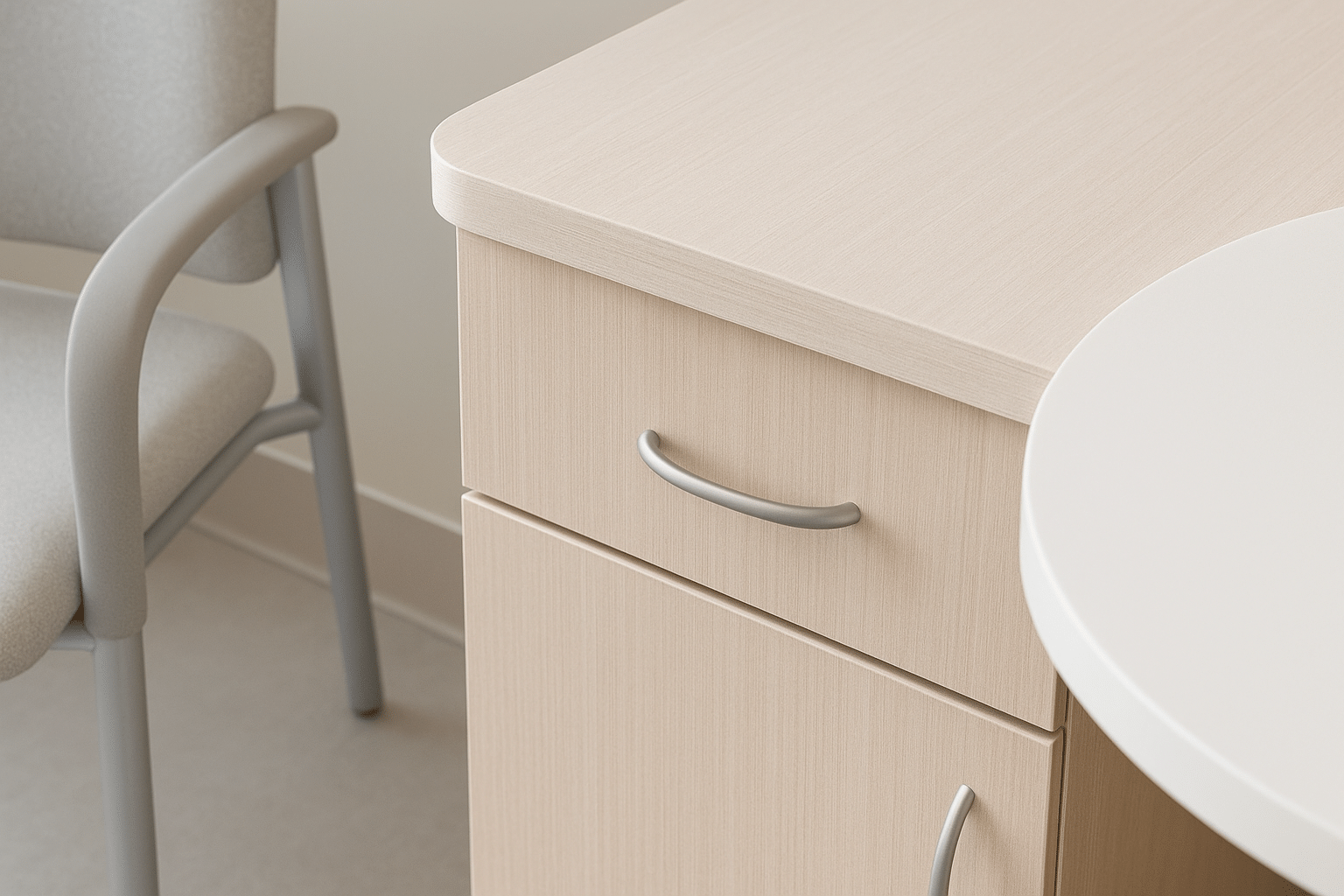
A glued edge band is the first thing to fail on a nurse station, a lab casework run, or a hot-desking bench. 3DL thermofoil sidesteps that failure entirely by wrapping the face, the profile, and the edges of a component in one continuous film, which is why smooth surfaces have become the default spec in healthcare and office furniture rather than a premium upgrade. The design conversation in 2026 has shifted from what a surface looks like to how many places it can come apart.
Where Edge-Banded Panels Break Down First
PVC or ABS banding is applied to a cut panel edge with hot melt or PUR adhesive, which means every component carries a glue line running the full perimeter. That line is a mechanical joint, and mechanical joints respond badly to the three things commercial casework sees daily: moisture, heat, and repeated chemical wiping.
In clinical environments the sequence is predictable. Quaternary ammonium and bleach-based wipes wick into the seam, the adhesive softens, a corner lifts, and within weeks the exposed particleboard or MDF core swells. Facilities teams usually notice it on the bottom edges of base cabinets and along the strike edges of doors, where mop water and cart impacts concentrate.
- Chemical attack at the glue line: repeated disinfection is the single largest cause of premature band failure on patient-room casework.
- Impact damage: gurneys, carts, and chair casters chip banding at exactly the height they contact it.
- Soil harborage: a lifted or shrunken band creates a gap that cannot be reliably wiped clean.
- Visual aging: even intact banding rarely matches the face laminate perfectly after a few years of UV exposure.
How Membrane Pressing Creates One Continuous Skin
3D laminate, sometimes called laminate thermofoil or simply thermofoil, is a decorative film that is membrane pressed over a routed and profiled substrate. The component goes into a vacuum press, the film is heated to roughly 250 to 320 degrees Fahrenheit depending on the resin system, and atmospheric pressure drives it down over every contour before the adhesive sets.
The result is a single skin with no termination point. There is no edge band because there is no separate edge component, and the film wraps around routed profiles, finger pulls, radiused corners, and grooves in one operation. That is the structural reason 3DL eliminates the most common maintenance callback in commercial millwork.
Design freedom follows from the same physics. A routed shaker profile, an integrated pull, a curved reception transaction top, or a tambour-look texture can all be produced in a single pressing, where an edge-banded approach would require five or six separate operations and would still leave visible seams at every mitre. Our PENTADECOR 3DL film program covers the depth and elongation ranges those profiles demand.
The Infection Control Case for Smooth Casework
The CDC’s Guidelines for Environmental Infection Control in Health-Care Facilities are explicit that surfaces in patient care areas need to be non-porous, smooth, and compatible with the facility’s disinfection protocol. Seams, cracks, and crevices are called out specifically because they defeat wiping: a disinfectant needs full contact and a defined wet dwell time to work, and a 0.5 mm gap at a lifted band does not get either.
Environmental services staff are also working faster than they did a decade ago, with typical terminal clean windows for a patient room running 25 to 40 minutes. A smooth wrapped surface can be wiped in one pass without a technician having to work a cloth into a joint. That is a small ergonomic detail that compounds across thousands of cleanings per year.
Chemical resistance matters as much as geometry. Specify films rated for the disinfectants actually in use on the unit, because a surface that passes a generic cleanability test can still haze or chalk under daily accelerated hydrogen peroxide. Projects in our healthcare market applications typically start with that disinfectant list before anyone picks a color.
What Office Furniture Designers Are Doing With It in 2026
Workplace specification has moved toward residential-feeling materials with commercial performance, and 3DL sits directly in that overlap. Super matte woodgrains, warm neutral solids, and synchronized-texture films now read as real veneer or painted millwork at normal viewing distance while wiping down like a lab surface.
Height-adjustable desk fronts, phone booth interiors, and modular storage towers are the volume applications, mostly because they involve high-touch edges that would otherwise be banded on all four sides. Curved reception desks and acoustic-panel frames follow close behind. If you are weighing finish behavior under fingerprints and daily contact, our comparison of super matte versus high gloss finishes covers the maintenance tradeoffs in detail.
The same films run on countertops and worksurfaces with a postformed or wrapped edge, which removes the dark seam line that always telegraphs on a laminated deck. For a broader look at commercial interiors, see our office and commercial applications.
Specifying 3DL: What Actually Goes on the Drawing
Membrane pressing has real geometric limits, and most production problems trace back to a profile drawn without them in mind. A few numbers worth writing into the spec:
- Substrate: 45 to 50 lb density MDF is standard, because particleboard telegraphs its chip structure through thin films on routed edges.
- Minimum inside radius: generally 2 to 3 mm; tighter corners risk bridging or film thinning at the apex.
- Film gauge: roughly 0.30 to 0.55 mm for most commercial work, with heavier gauges for deep profiles and high-impact edges.
- Back side treatment: a balancing backer or second-surface film prevents warp on tall doors.
- Heat exposure: keep wrapped components away from unshielded heat sources, a limit that matters more for kitchens and cabinets near appliances than for office casework.
Color and texture matching across product lines is the other frequent hang-up, especially when a project mixes 2D and 3D films on different components. The SSI 2DL and 3DL cross reference charts exist for exactly that coordination problem.
Cost of Ownership Versus Banded Panels
Per square foot, a membrane pressed component and an edge-banded panel often land within 10 to 20 percent of each other at the point of purchase, depending on profile complexity and run size. The gap opens over the service life. Casework in a busy clinic frequently needs edge repair or door replacement at the five to eight year mark, while a wrapped component with no glue line tends to age as a finish issue rather than a structural one.
Fabricators also save on operations: no banding machine setup, no trimming, no scraping, no corner rounding, and fewer QC rejections from glue squeeze-out. Furniture built to BIFMA durability criteria benefits from having fewer joints to test in the first place. Advances on the banding side are real too, and our overview of newer edgebanding technologies explains where laser and zero-joint methods still make sense.
Frequently Asked Questions
Does 3DL Thermofoil Really Eliminate Edge Banding Completely?
Yes, on any component that can be membrane pressed as a single piece, which covers most doors, drawer fronts, panels, and profiled millwork. Large casework boxes and some worksurface assemblies may still use a banded or wrapped edge on one hidden face, but the visible, high-touch edges are continuous film.
What Is the Difference Between 2D and 3D Laminate?
2D laminates are flat-applied films for level surfaces, while 3D laminates stretch and conform over contours in a vacuum press. The practical dividing line is elongation: 3DL films are engineered to stretch 40 percent or more without losing color or texture on a routed profile.
Can 3DL Surfaces Handle Hospital-Grade Disinfectants?
Most commercial-grade 3D laminate films tolerate quaternary ammonium, alcohol, and diluted bleach solutions used at label concentration and dwell time. Always confirm compatibility against the specific product list for the facility, since accelerated hydrogen peroxide and phenolics vary in aggressiveness.
Are 3D Laminates Suitable for Countertops?
They work well on vertical surfaces, cabinet faces, and light-duty worksurfaces such as reception transaction tops. For heavy horizontal work with hot items or standing water, a solid surface or compact laminate deck paired with 3DL fronts is the more durable combination.
Where Do You Buy Thermofoil Sheets and Rolls?
Thermofoil sheets and roll stock are sold through decorative surfacing suppliers who serve membrane pressing shops, typically in widths from 51 to 61 inches. Minimums, texture availability, and lead times vary by film line, so request current samples before locking a color into a submittal.
Request 3DL Samples for Your Next Specification
Send us the disinfectant list, the profile drawings, and the color direction, and we will match films that hold up to both. Samples and cross-reference support are available for healthcare, workplace, and architectural millwork projects.
