
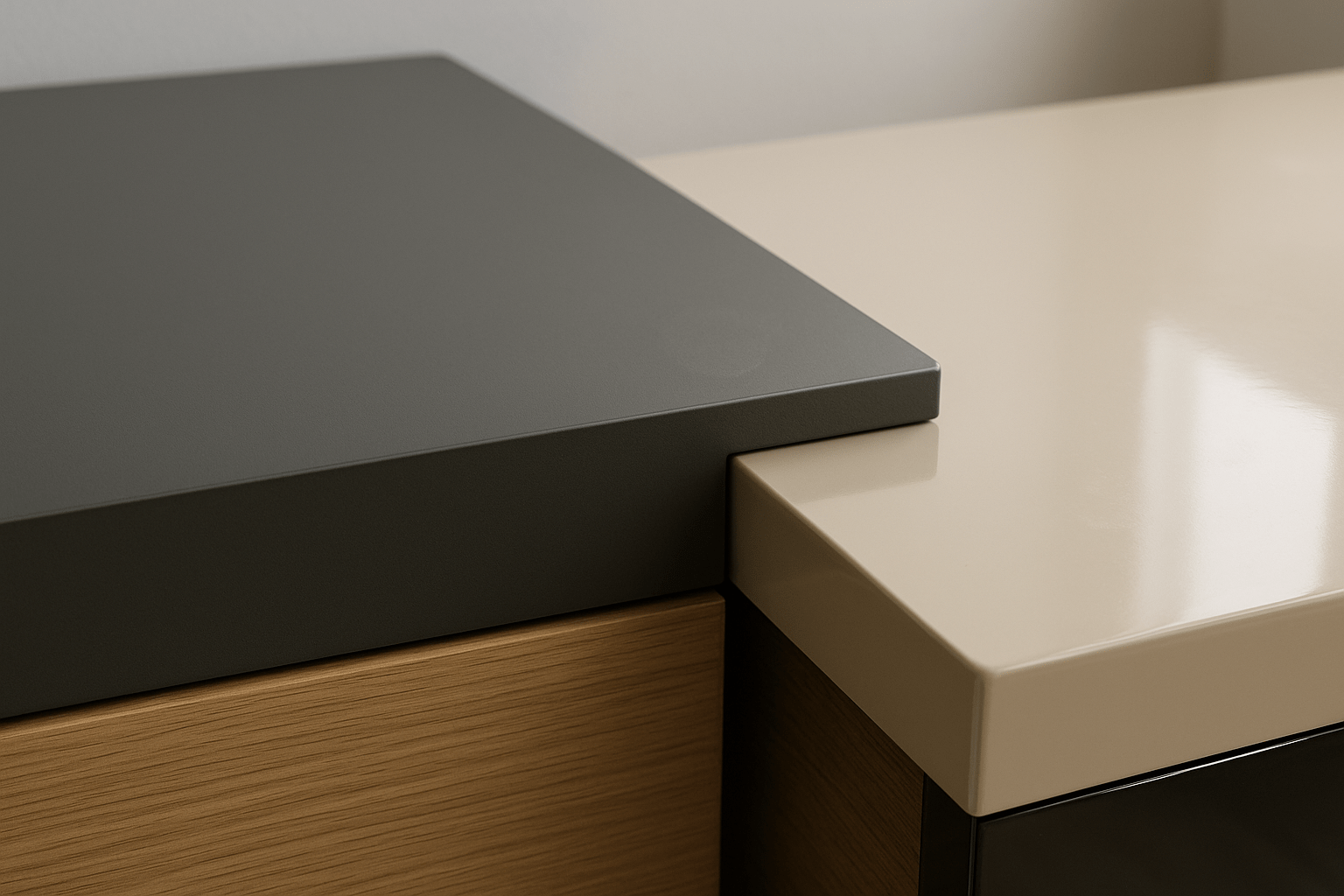
The choice between super matte and high gloss finishes comes down to how a surface behaves after six months of hands, cleaning cloths, and sunlight, not how it photographs on a showroom door. Super matte hides fingerprints and diffuses light; high gloss reflects light, brightens tight rooms, and shows every smudge and swirl mark. This guide compares both on maintenance, smudge resistance, and natural wear so you can spec the right finish for real furniture in real spaces.
What Super Matte Actually Means (In Numbers)
Gloss is measured in gloss units (GU) at a fixed angle, usually 60 degrees, using a gloss meter calibrated to standards published by ASTM International. A true super matte finish typically reads between 1 and 4 GU, which is low enough that the surface scatters nearly all incident light instead of bouncing it back at you.
That low reading is why super matte reads as velvety and almost chalky to the eye, with a soft tactile drag when you run a hand across it. Many modern super matte films also carry an anti-fingerprint (AF) topcoat, and some include self-healing chemistry that lets shallow micro-scratches close up with gentle heat. The Pentadecor 3D Laminate Super Matte line was engineered around exactly that combination of low sheen and surface protection.
What High Gloss Means, and Why Designers Still Want It
High gloss laminates generally measure 85 to 95 GU or higher, giving a mirror-like plane that reflects cabinetry, light fixtures, and daylight back into the room. That reflectivity is a legitimate design tool, not just decoration.
- Perceived space: gloss doors visually widen galley kitchens and small bathrooms by bouncing light off opposing walls.
- Color depth: deep blues, blacks, and reds gain saturation under a gloss layer that a matte finish flattens.
- Cleanability of spills: the closed, slick surface releases grease, sauce, and marker faster than most textured alternatives.
- Contemporary read: gloss still signals a crisp, high-end modern look in retail and hospitality millwork.
The Smudge Problem: Why Fingerprints Show Where They Do
Fingerprints are mostly water, salts, and skin oils, and they become visible when the residue changes how light leaves the surface. On high gloss, the oil film sits on a perfectly specular plane, so it interrupts the reflection and shows as a dull, cloudy patch that catches the eye from across the room.
On super matte, the same oil partially fills the micro-texture, which can create a slightly shinier spot rather than a dull one. The difference is contrast: a matte surface at 2 GU shifts only a few units when smudged, while a 90 GU panel loses reflection sharply and reads as visibly dirty.
In practice, both finishes smudge. Super matte with an anti-fingerprint layer simply hides it better, and darker gloss colors are the hardest of all to keep looking clean in day-to-day use.
Maintenance in Practice: What Each Finish Asks of You
The honest maintenance comparison is about frequency and technique, not one finish being maintenance-free. Most kitchens with dark high gloss doors need a wipe-down every one to three days to look their best; comparable super matte doors usually go a week or more between full wipes.
We cover this topic in more depth in Design Trends in Seamless Surfaces: How 3DL Thermofoil Eliminates Edge Banding in Healthcare and Office Furniture.
Cleaning super matte
- Use a clean, damp microfiber cloth with a few drops of pH-neutral dish soap, then dry immediately.
- Skip abrasive pads, powdered cleansers, and melamine “magic” erasers, which polish the micro-texture and create permanent shiny halos.
- Avoid solvent-heavy cleaners with acetone or high-concentration alcohols on a routine basis; spot-test any disinfectant first, and confirm compatibility against the manufacturer’s list of EPA approved disinfectants.
Cleaning high gloss
- Wipe in one direction with a lint-free microfiber cloth, never in circles, to prevent visible swirl patterns.
- Follow damp cleaning with a dry buff, since dried water spots and detergent residue are more obvious than the smudge you removed.
- Keep grit off the cloth; a single sand particle dragged across a gloss panel leaves a scratch you will see for years.
Natural Wear: The Five-Year View
Both finishes age, but they age differently, and that difference matters more than first-day appearance when you are specifying for multifamily or commercial work. High gloss accumulates fine micro-scratches that eventually read as a hazy bloom under direct light, most noticeably around handles, drawer fronts, and appliance pulls.
Super matte hides scratches better because there is no mirror surface to disturb, but it is vulnerable to burnishing: repeated rubbing in one spot raises local sheen and creates a shiny patch that cannot be scrubbed away. Self-healing super matte films reduce this, though they do not eliminate it on high-contact edges.
Cabinet fronts specified to the ANSI/KCMA A161.1 performance standard published by the Kitchen Cabinet Manufacturers Association must survive structural, finish, and chemical-resistance testing, which is a useful baseline when you compare films across suppliers. Our notes on 2D and 3D laminates in high-traffic environments go deeper on that durability question.
The Spec Decision: Matching Finish to Room and Traffic
Most articles stop at “matte hides fingerprints.” The more useful framework is to match sheen to the traffic level, lighting, and cleaning staff of the actual space.
- Family kitchens and bath vanities: super matte on base cabinets and drawers where hands land constantly, with gloss reserved for uppers if you want the light bounce. See our residential kitchen and bath applications for typical pairings.
- Multifamily turns: super matte, because touch-up and repainting between tenants is not realistic and matte hides transitional wear longer.
- Retail and hospitality feature walls: high gloss above the touch zone, roughly 48 inches and higher, where reflections work and hands do not reach.
- Home offices and closets: super matte reduces screen glare and reads calmer in low, indirect light.
- Healthcare and education casework: favor cleanability and chemical resistance over sheen; verify disinfectant compatibility before you commit.
Cost, Color, and Mixing the Two Finishes
Pricing is close enough that finish should rarely be the budget decision. Premium super matte films with anti-fingerprint and self-healing layers usually carry a modest upcharge over standard sheens, while high gloss costs come mainly from fabrication: gloss panels require more careful handling, protective masking, and higher reject rates because defects show.
Mixing finishes works well when you assign each a job. A common approach is super matte perimeter cabinetry with a high gloss or mirrored island face, or matte doors framed by a gloss backsplash, an idea that suits the layered palettes we describe in mid-century modern laminate designs and in our guide to modernist decorative laminate ideas. Keep the color family consistent so the sheen contrast reads intentional rather than mismatched.
Frequently Asked Questions
Is glossy or matte better for a wardrobe?
Matte is better for most wardrobes, since wardrobe doors are touched several times a day at chest height where fingerprints show worst. Gloss can still work on a bedroom wardrobe if the room is small and dark, because the reflection adds perceived depth, but plan on wiping the doors weekly.
What finish is better, matte or glossy?
Super matte is the better all-around choice for high-touch furniture, and high gloss is better where light reflection and color saturation matter more than smudge resistance. Matte wins on daily upkeep and scratch camouflage; gloss wins on brightness and easy spill release.
Which finish is more expensive, matte or glossy?
The two are usually within about 5 to 15 percent of each other at the material level, with premium anti-fingerprint super matte films at the higher end. High gloss often costs more once installed because fabrication tolerances, protective film, and defect rejection add labor.
Which finish is better for kitchen cabinets, glossy or matte?
Super matte is better for kitchen cabinets in most households, particularly on lower cabinets and drawer fronts that absorb constant contact. High gloss remains a strong option for upper cabinets, small kitchens needing light, and homes where someone genuinely enjoys frequent wipe-downs.
Choosing a Finish for Your Next Program?
Order samples and compare the sheen levels in your own lighting before you commit a full production run. Contact SSI North America to request super matte and high gloss chips, or browse the current Look Books for color and texture pairings.
